
Cargo Pants for College Students in India: Choosing Baggy, Comfy Cargo Pants for Girls in India
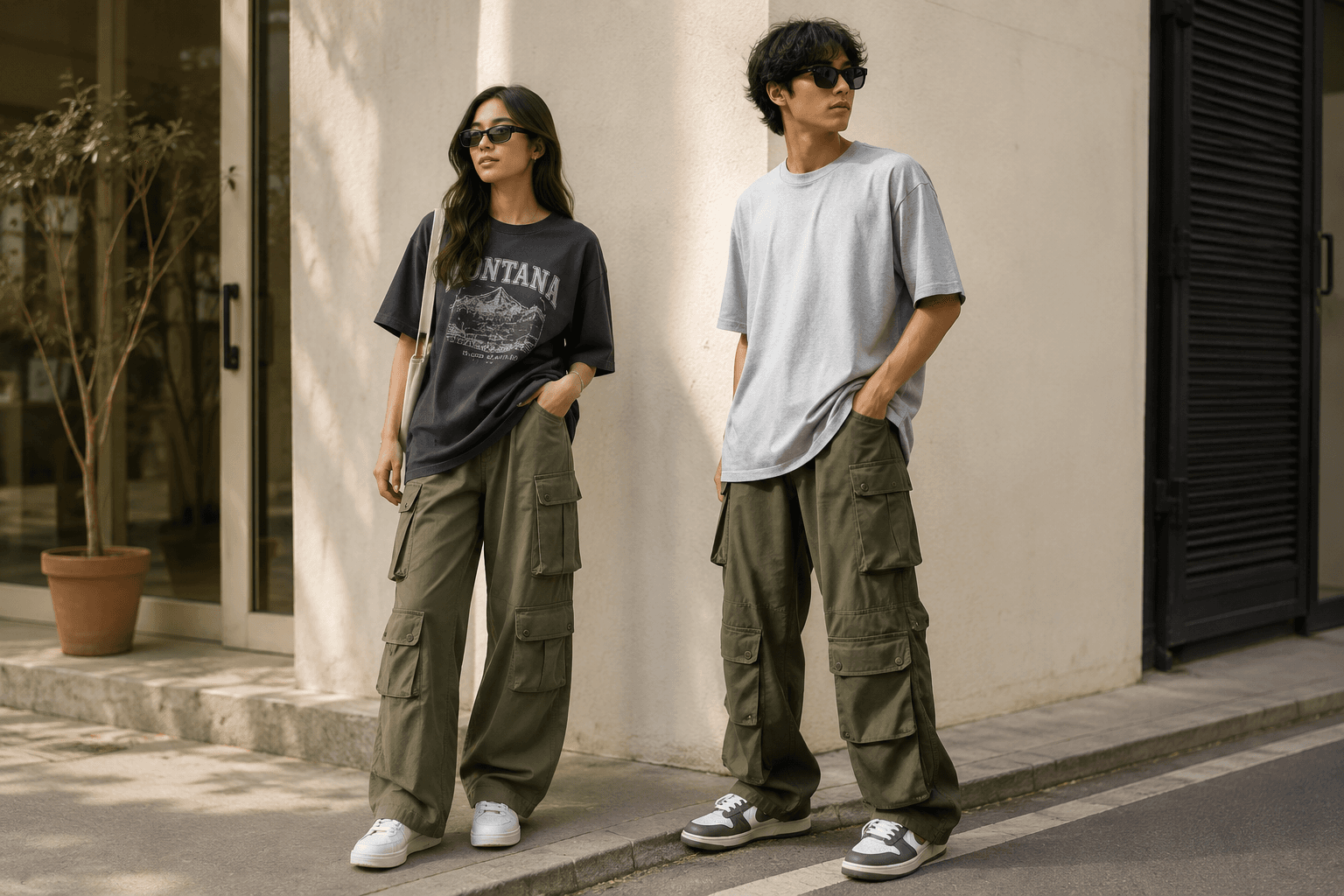
Cargo pants for college students in India work best in cotton or cotton-twill blends weighing 220–300 GSM, cut baggy or wide-leg with a mid-to-high rise. Expect to pay ₹899–₹1,499 for a well-stitched daily-wear pair. Check hem width and rise before ordering, not just waist size.
You order at 11 p.m., pick your usual size, and three days later the waistband gapes and the hem drags along the corridor floor. Almost every college shopper in India has had that experience.
Cargo pants are easy to buy badly. Photos are shot on 5’9″ models, size charts are copied from UK templates, and fabric weight is rarely printed.
This guide covers how to read a spec sheet, what a fair price looks like after the September 2025 GST revision, and how to test a pair before returns close.
Key takeaways
- Cotton twill at 220–300 GSM outlasts 160 GSM polyester on Indian campuses.
- Garments up to ₹2,500 attract 5% GST since 22 September 2025.
- Rise and hem width decide comfort more than waist size does.
- Run the 3S Campus Test inside your 7-day return window.
Cargo Pants for Girls in India: What Fabric and Fit Actually Matter
Fabric weight and rise height decide whether a pair survives a semester. Weight is measured in GSM, or grams per square metre, and tells you how dense the cloth is. Rise is the distance from the crotch seam to the waistband top. Most disappointing pairs fail on one of those numbers, not on styling.
What fabric works for comfortable cotton cargo pants for daily college wear in India?
Cotton twill in the 220–300 GSM range is the practical choice for daily college wear in India. Twill is a woven fabric with a diagonal rib, the same weave family as denim, and it resists abrasion from bag straps and chair edges.
Fabric guides published in 2026 place cotton trousers between 200 and 350 GSM, with roughly 280 GSM treated as a year-round weight. Heavy workwear cargos run 300–380 GSM, warm for Delhi NCR in May.
I tested this the hard way. Two pairs of the same declared size weighed 620 g and 890 g on my kitchen scale. The lighter pair bagged permanently at the knee after three washes.
Cotton breathes and absorbs sweat, while polyester dries faster but traps heat. A 95% cotton, 5% elastane blend suits long lectures.
How do you read GSM on a product page?
Look for a “fabric weight” or “GSM” line in the specifications block. If the brand does not publish that number, the silence is information.
Many Indian labels list only “premium cotton”, which is not measurable. MumsStitch publishes fabric composition on every product page at mumsstitch
Where to Buy Baggy Cargo Pants Online in India Without Guessing Your Size
Buy from sellers who publish a garment-measurement chart, not just an S/M/L label. A garment chart lists the flat measurements of the item itself, while a body chart lists the wearer’s measurements, which helps far less with a baggy cut.
Where can you buy baggy cargo pants for college girls online?
Baggy cargo pants for college girls are sold online through marketplaces such as Myntra, Amazon India and Flipkart, and through direct-to-consumer labels including MumsStitch. Marketplaces offer volume and speed. Direct labels usually offer better fabric disclosure across a smaller catalogue.
Prioritise three things: a garment-measurement chart, a return window of at least seven days, and cash on delivery.
Ignore star ratings alone. Read the two-star and three-star reviews, because that is where sizing complaints appear.
Why do Indian size charts disagree with each other?
Indian brands have historically borrowed UK, US or EU size charts, none built on Indian body data. A “Medium” from two labels can differ by two inches at the hip.
The Ministry of Textiles and the National Institute of Fashion Technology are addressing this through INDIAsize, a national sizing survey scanning more than 25,000 people aged 15 to 65 across six regions, following ISO 8559, ISO 7250 and ISO 20685 protocols.
Until that chart is adopted industry-wide, measure trousers you already own and match the numbers. That habit removed most of my own return requests.
Wide Leg Cargo Trousers for Women: Getting the Proportions Right
Wide leg cargo trousers for women succeed or fail on hem width relative to height. A 22-inch hem opening reads as dramatic drape at 5’8″ and as a puddle at 5’2″. Thigh pockets set too low also widen the leg visually.
How wide should the hem be for your height?
Aim for a hem opening of 16–18 inches under 5’4″, 18–20 inches between 5’4″ and 5’7″, and 20–22 inches above 5’7″. These are flat measurements, so double them for circumference.
I ignored this once and ordered a 22-inch hem at 5’2″. During the Ghaziabad monsoon, the hem wicked water halfway up my calf on one walk to the campus gate.
Can you test the fit before the return window closes?
Yes, in under five minutes. I use a checklist I call the 3S Campus Test, built after returning four pairs in one semester.
- Sit. Sit cross-legged on the floor for 60 seconds. The waistband should not dig in or slide down at the back.
- Stack. Load the thigh pockets with a phone, charger and earbuds, roughly 350 g. Walk 20 steps. Pockets that sag or swing are stitched too low.
- Stride. Climb two flights of stairs. If the hem catches under your heel, the inseam is too long for your frame.
What Should You Pay for Cargo Pants in India Right Now?
A well-made cotton pair costs ₹899 to ₹1,499 in India as of July 2026. Below ₹800, fabric weight almost always drops under 200 GSM. Above ₹2,500, you cross a tax threshold without gaining durability.
What are the best cargo pants for college students in India under ₹1500?
The best cargo pants for college students in India under 1500 share four traits: cotton-dominant twill above 220 GSM, bar-tacked pocket corners, a published garment chart, and a seven-day return window.
| Price band | Typical fabric | What you usually get | Trade-off |
|---|---|---|---|
| ₹499–₹799 | Poly-cotton, 160–200 GSM | Trend-correct shape | Fades in 4–6 washes |
| ₹899–₹1,499 | Cotton twill, 220–300 GSM | Bar-tacked pockets, real garment chart | Slight first-wash shrinkage |
| ₹1,500–₹2,500 | Cotton twill, 300 GSM+ | Reinforced seams, sturdier hardware | Warm for Indian summers |
| Above ₹2,500 | Premium or designer twill | Finishing detail, brand name | 18% GST makes the jump steep |
Why did apparel pricing shift in September 2025?
India revised its garment tax slabs effective 22 September 2025. According to the Press Information Bureau, the 5% GST rate now covers readymade garments priced up to ₹2,500 per piece, raised from the earlier ₹1,000 threshold. Garments above ₹2,500 moved from 12% to 18%. A ₹1,400 pair that once carried 12% GST now carries 5%.
IMARC Group valued India’s women’s apparel market at USD 93.2 billion in 2024, projecting USD 121.6 billion by 2033. Estimates vary between research firms, so treat any single figure as directional.
Who this is for: students buying cotton cargo pants between ₹500 and ₹2,500 online, with returns available. Who it is not for: tactical or military-specification trousers, made-to-measure orders, or campuses with formal dress codes. No fabric weight guarantees a lifespan.
Frequently Asked Questions
Are baggy cargo pants suitable for Indian summers?
Yes, if the fabric is breathable cotton at 220–260 GSM rather than polyester. Baggy cuts allow airflow around the leg, which helps in humid conditions. Avoid pairs above 300 GSM between April and July in North India, since heavy twill traps heat outdoors.
How do I stop cotton cargo pants from shrinking?
Wash in cold water below 30°C and skip the tumble dryer. Cotton twill typically shrinks 2–3% on the first wash, mostly in length. Buy one inch longer in the inseam if the brand states the fabric is unwashed, and dry flat in shade.
What tops work with wide leg cargo trousers?
Fitted tops balance volume below the waist. A tucked-in crop top, ribbed tee or short fitted shirt keeps proportions readable. Oversized tops hide the waistline entirely, which shortens the visual leg line. Add a belt if the waistband sits loose.
Is cotton or polyester better during the monsoon?
Polyester dries faster, which suits heavy rain. Cotton stays comfortable against skin but holds water and takes several hours to dry indoors. A 65:35 cotton-polyester blend is a sensible monsoon compromise. Cuff the hem to keep fabric off wet pavement.
How many pairs does a college student actually need?
Two pairs cover a typical week: one neutral shade such as black or olive, and one lighter tone such as beige. That rotation lets one pair dry fully while the other is worn. A third pair helps only if laundry runs past four days.
The Short Version Before You Order
Fabric weight, rise and hem width decide comfort. Price bands signal what fabric to expect, and the 5% GST slab up to ₹2,500 keeps quality cotton within a student budget. Measure a pair you already own, match the garment chart, and run the 3S Campus Test the day your parcel arrives.
Browse the cotton cargo range at MumsStitch and check fabric composition before ordering.
About the author
Saurabh Kumar writes on apparel sourcing and fit for Indian direct-to-consumer brands. He has spent four years reviewing fabric specifications, garment charts and return data for online fashion catalogues serving student buyers.